by Dick van Niekerk
Jan Hus (1369 – 1415) was a charismatic preacher who from 1402 onward often spoke twice a day in the famous Bethlehem Chapel in the heart of Prague. According to eyewitnesses he had a magnetic effect on his public. He knew how to win the hearts of his audience by consistently preaching in Czech. Hundreds of believers thronged daily to the Bethlehem Chapel. Amongst them was the wife of King Wenceslas, Queen Sophie, for whom a private auditorium was built within the church, with its own entrance so that she would not have to sit amongst the populace. Hus was also her personal confessor.
The interest of the monarch did not prevent Hus, in addition to his usual exegesis, from speaking out against the wealthy clergy, the laxity of the church dignitaries and the efforts of the church to increase its wealth. ‘These priests… are drunkards whose bellies rumble with drink and they are so greedy that they fill their bellies until their double chin hangs down’. With such statements he put his personal freedom at stake, especially as he continued to question the leadership within the church. ‘The Pope may only be Christ’s deputy on earth when he is a faithful servant of the salvation of Jesus Christ.’ In other words: if someone becomes Pope without directly being chosen by God, must he then be obeyed? Such questions would naturally provoke an explosive reaction by the threatened religious establishment.
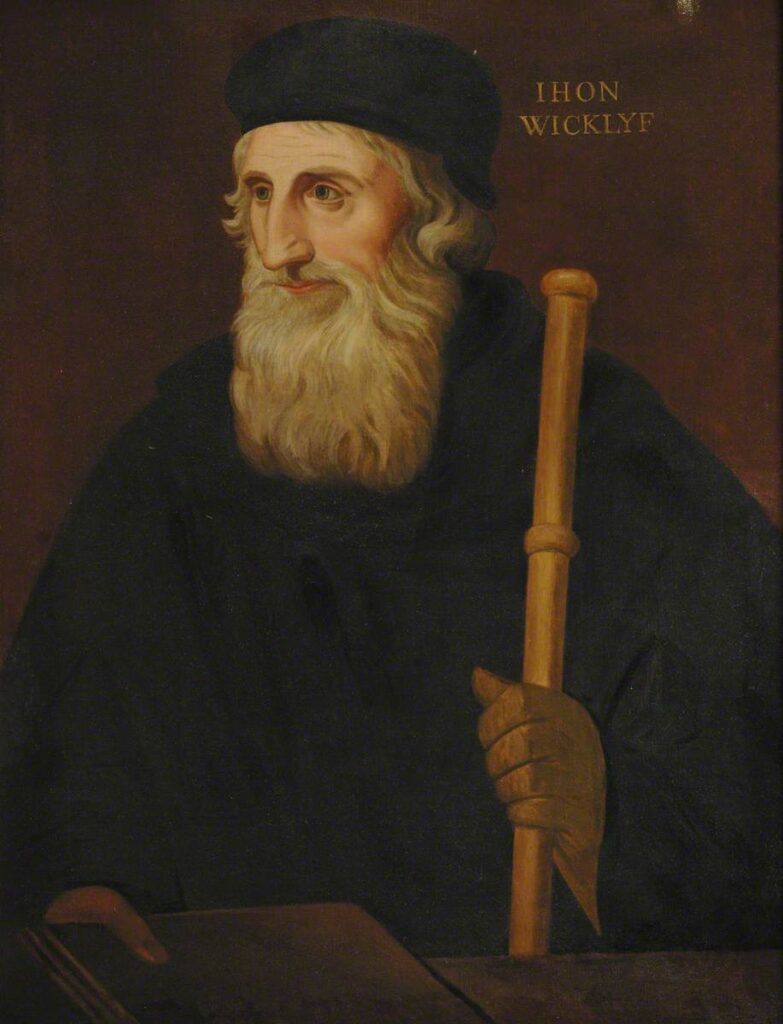
In all his works Hus returns to the Bible as the only living source for the issuing of directives and decisions within the church. He relied on the views formed three decades earlier by the English priest and theologian, John Wycliffe, the ‘silent source’ of inspiration for Hus’ theological works.
The treatises of Wycliffe
Hus became familiar with the treatises of Wycliffe thanks to his erudite companion Jerome of Prague, who in 1382 brought them from London to Prague when Richard II of England married Anne of Bohemia. Wycliffe, a great propagandist of the proclamation of the Word of God in the native language of the people, seems to have been influenced by Cathar-Bogomil beliefs.
Hus translated Wycliffe’s theses almost literally into Czech without a moment’s thought about the source from which it came. Plagiarism was then an unknown concept. But in practice Hus took a more nuanced approach than Wycliffe.
In this great church reformer budded a consciousness that emerged as a new religious way of thinking in which the balance between the God of the higher nature and the human being became a personal matter. It demonstrated the intense need that had grown viz. to live by the standards that are called in Czech ‘Swet’, which translates as ‘primordial light’ – the high ideals of the ‘Imitation of Christ’. In the good company of humanists such as Erasmus, Hus laid the basis for a Christianity in which man could follow his own conscience, and spiritual experiences were set above church dogma.
Together his works also acted as a catalyst in a social struggle that would soon ignite the age-old conflict between authority and individual freedom, between centralisation and decentralisation, between the ruling class and the people.
WYCLIFFE: Everyone has the right to read the Bible
In the run-up to the Council of Constance, King Sigismund, who took office in 1411, managed to convince Hus – for the benefit of peace in his kingdom and within the church – to defend his position in the city of Constance. Hus agreed on the condition that the king would promise that he would not be harmed, that he would be granted a letter of safe passage, and that during his travels he would be at the king’s side as a trustee. Hus prepared three impassioned speeches and seemed convinced that he could win the Council over with his vision. At the beginning of October 1414 he began his journey. At first there was still talk of travelling alongside the king, but Sigismund eventually arrived two months later. In truth, they would have had a hard time bearing each other: Hus, the severe ascetic and Sigismund, the power-politician living in Burgundian style. The supervisor, promised by the king was not present when Hus, cheerful and full of confidence, travelled to lake Constance.
An exhaustive battle
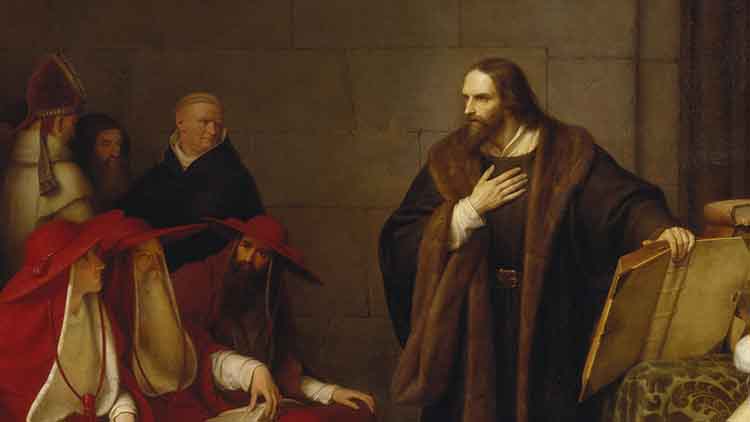
Hus received a warm reception almost everywhere he stayed in Central Europe, however not in Constance. After a few days he was, by order of the cardinals, imprisoned in a dank room, supposedly so that they could come to listen to him. It became an attrition of many weeks of daily interrogations and backbreaking disputes with the College of Cardinals. Hus was served with the ’45 Articles of Wycliffe’ with the request that he renounce them. He renounced a few and he openly questioned whether some others were not incorrectly formulated by the interrogator. But he stayed unwaveringly steadfast to the underlying intention of the articles and to Wycliffe’s church vision: Jesus Christ is the head of the true church.
Hus was repeatedly asked to revoke his views. He refused, finding inner strength in John 8:32 (And you will know the Truth, and the Truth will set you free) which he translated in his own statement: ‘seek the truth, learn the truth, love the truth, speak the truth, preserve the truth and defend the truth until death.’
Leviticus
King Sigismund intervened after several months. He let Hus know that if he did not distance himself from his own views, it would be impossible to guarantee his safety any longer. Sigismund ordained three public debates at which he himself would be present and for which ‘top theologians’ would be deployed. One of them, Johannes Zacharias from Erfurt, planned to ‘catch’ Hus on an irregularity in his interpretation of a few phrases from the Old Testament book of Leviticus. The theologian was the ‘winner’ of the debate and let himself be adorned with a white rose. He is regarded as one of the people who succeeded in committing Jan Hus to the stake.
It was the most striking ‘merit’ of Zacharia’s curriculum vitae, who after his death was interred in a mausoleum under the alter of the cathedral in Erfurt.
Subsequently Sigismund withdrew his support of Hus. On July 6, 1415, during a plenary session of the Council in the Muenster church of Constance, the ‘unrepentant arch-heretic’ Hus, was condemned to death.
O holy simplicity
When the flames held him in their grip, there came an old lady who hastened to add a branch to the pyre. Hus called out ‘sancta simplicitas’ -O holy simplicity – and gave his body finally up to the fire. Then the executioners took his ashes in a cart to the Rhine and scattered them in the river. This scattering was a ‘damnatio memoriae’ – an act to erase all memory of the heretic. ‘Is this your safe passage?’ Hus scornfully asked as he passed King Sigismund on his way to the pyre, causing Sigismund to blush heavily. That all-revealing blush of shame was written up in the history books and a century later when Charles V ordered the arrest of the heretic Luther, he referred to Sigismund by commenting ‘And I don’t intend to blush’
On the 30th May 1416 Hus’ friend Jerome of Prague met the same fate at the same location. The Richental Chronicle states ‘When they led him outside, he prayed the creed of faith. He then sang the litany “Christus vincit, Christus regnant, Christus imperat!”– Christ conquers, Christ rules, Christ reigns) and then prayed the creed once more. He did not make a confession. Jerome was a powerful and strong man with a thick black beard; due to his strength he stayed alive during his execution longer than Hus. After his execution his ashes and all the remains of the fire were scattered in the Rhine. Many learned men were deeply saddened by his death as he was a notable master of the free arts in Prague, London, Cologne, and Erfurt.
 This article was originally published in “Friesch Dagblad”, newspaper for Fryslån, The Netherlands, July 7 2015
Dick van Niekerk is a researcher, journalist and editor based in the Netherlands.